Service
Interior basement waterproofing: drains and wall barriers
An interior system does not keep water away from the house. It gives the water that arrives an easy route to a pump, so it never spreads over the floor.
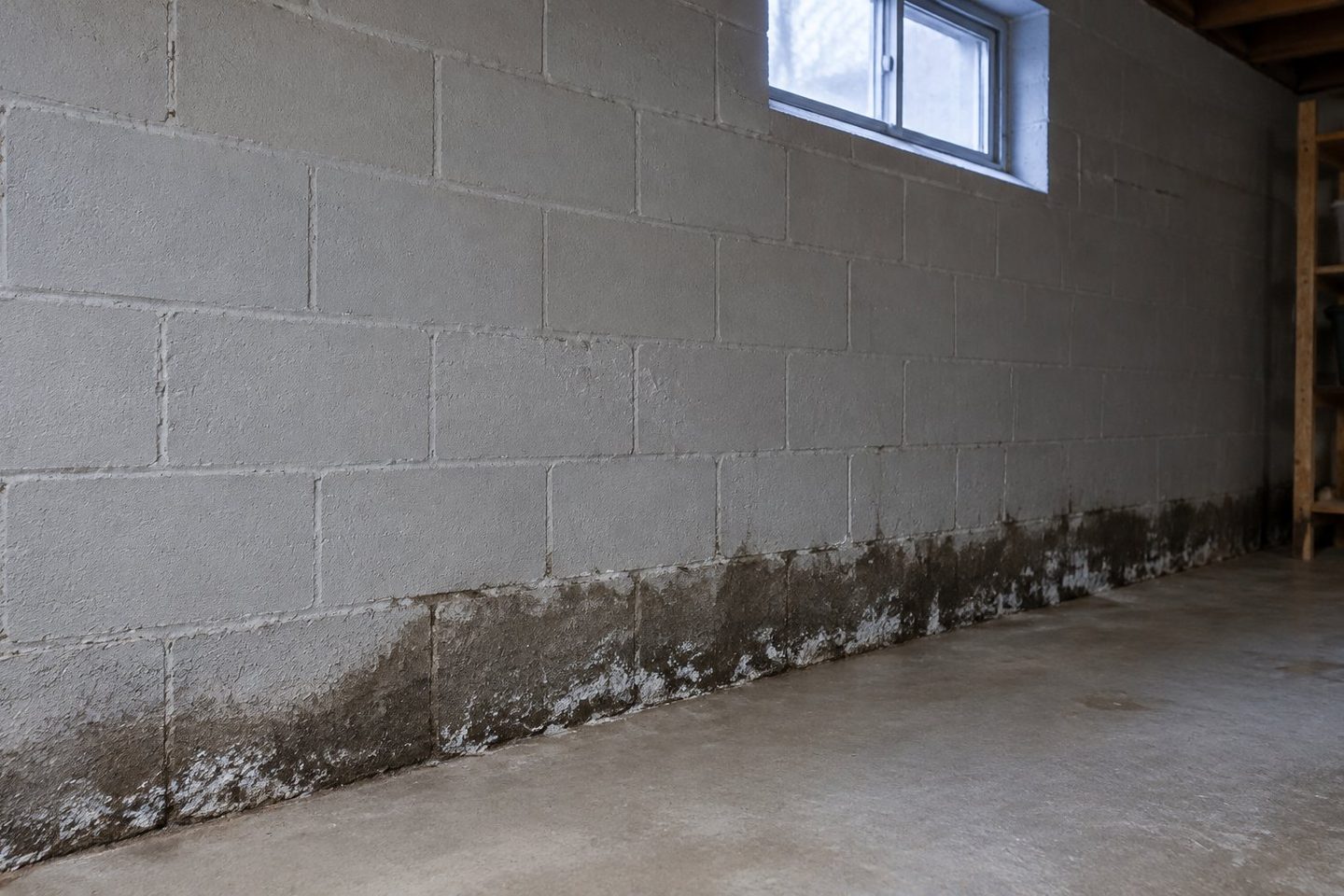
The problem it solves
After a long rain the ground under and around a basement fills with water. The slab and the walls were poured or laid separately, so there is a seam all the way round where they meet. That seam is where the water comes up. Hollow block walls add a second route: the cores inside the blocks fill like a row of bottles and weep through the bottom course.
If your water shows up as a line along the wall rather than at one crack, and it follows wet weather by hours, this is the page for you.
How the drain goes in
A strip of floor comes out
The slab is cut and broken out along the wet walls, usually about a foot wide, down to the footing.
Block walls are opened at the bottom
Small holes are drilled into each hollow core so the water standing inside the wall can drain into the trench instead of through the paint.
Pipe and stone go in
A perforated pipe is bedded in washed gravel beside the footing, sloped toward the corner where the sump basin sits.
The wall gets a barrier, if needed
A plastic sheet or rigid panel is fixed to the wall so anything that seeps through runs down behind it into the drain. This is what lets a wall be finished later.
The floor is closed again
New concrete covers the trench. Some systems leave a narrow gap at the wall so water running down the face can still drop in.
What it does to the house while it happens
Breaking concrete indoors is loud and dusty. Ask how the dust will be contained and whether the furnace should be off. Everything has to come away from the walls being worked on: shelving, the washer and dryer, stored boxes. Paneling or drywall on those walls is cut back at the bottom or removed.
The water heater, the furnace and the stairs often sit right on the line of the trench. Each company deals with them differently, by going around, tunneling under or stopping short. Find out which before you sign, because a gap in the drain is where water will show up next.
Ask before you agree to it
- Which walls get the drain, and what did you see that rules the others out?
- Where does the pump send the water, and how far from the house does the pipe end?
- Will you drill the block cores, and how do you keep the holes from clogging?
- What happens at the stairs, the furnace and the water heater?
- How thick is the new concrete, and will it sit level with the old floor?
- Does the warranty promise a dry floor, or only cover the parts? Does it pass to a buyer if I sell?
What usually goes with it
A drain needs somewhere to send the water, so a sump pump is nearly always part of the same job. A battery backup is worth the extra, because the storms that fill the drain are the ones that take out the power.
The wall will still be damp to the touch on the outside of the barrier, and the air will still be humid, so a dehumidifier often follows. And the downspouts should be dealt with first or at the same time. See exterior waterproofing and yard drainage.
Two things people ask about interior systems
Can it be done in a finished basement?
Yes, with damage. The bottom of the finished wall and a strip of flooring come out along every wall that gets the drain, and putting them back is usually a separate job by a separate trade. Get that cost before comparing it with digging outside.
Will an interior drain straighten a wall that is leaning in?
No. It relieves water, not soil pressure. A wall that has moved needs a structural opinion from an engineer or a foundation specialist before anyone covers it with a panel.
Montgomery and nearby towns
Ready to have someone look at it?
Call and describe what you are seeing and when it happens. You will be put through to an independent local waterproofing company, and they arrange the visit with you.
Phone calls may be recorded. See the referral disclosure and the privacy policy.